J Force: New Zealand’s Occupation of Japan 1945-1948
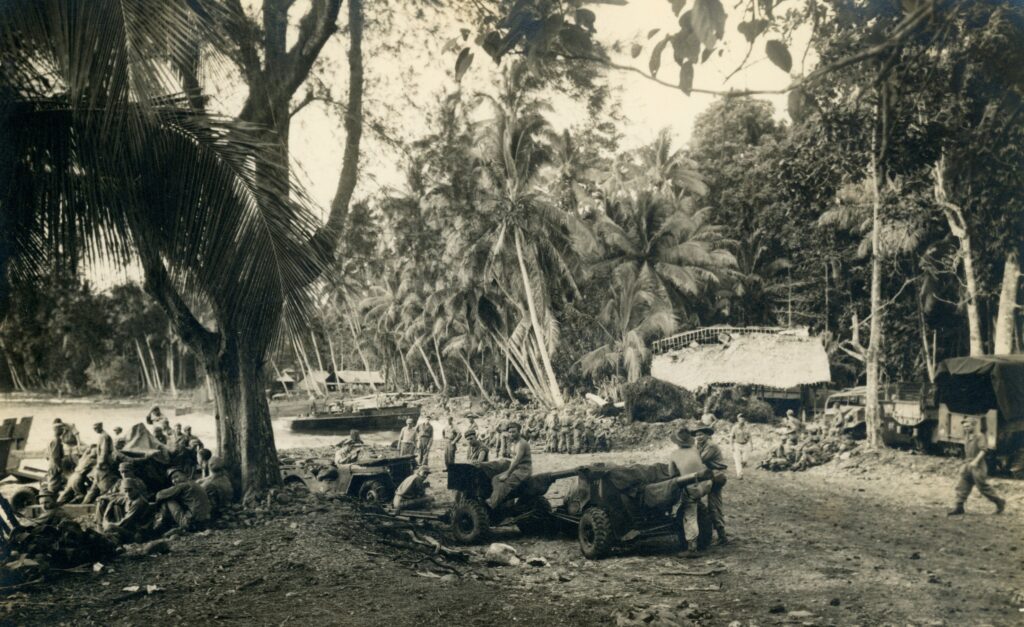
J Force was New Zealand’s contribution to the Allied occupation of Japan at the end of the Second World War, and our first international peacekeeping mission. Between 1945 and 1948, 12,000 men and women were made responsible for an area home to 2.1 million Japanese civilians. Our service personnel had to adapt to military life among an unfamiliar society, making friends with former enemies but forever at war with their own boredom. J Force: New Zealand’s Occupation of Japan 1945-1948 captures these experiences through seven key objects, each representing a different aspect of life in this often-overlooked chapter of our Army’s story.
Korea
The Korean War began in 1950 when the Communist North Korea invaded the South. The United Nations resolved to protect the South, and sent a force to fight alongside the South Koreans against the North Koreans and later the Communist Chinese. New Zealand sent an Artillery Regiment (16th Field Regiment) and supporting units (10 Transport Company, and Engineers and Signallers) to fight alongside other Commonwealth countries in a Commonwealth Brigade then a Commonwealth Division.
The contingent was known as Kayforce. On 25 April 1951 at Kapyong, 16 Field Regiment of the Royal New Zealand Artillery distinguished itself in battle by engaging the enemy in assistance of the 3rd Royal Australian Regiment (3RAR), who had been under sustained attack from the Chinese infantry. The New Zealand artillery rained down a huge amount of shells, halting the Chinese attack. Both units received Presidential Citations.
Korea was the coldest theatre to which New Zealand troops had been deployed. During the winter, the New Zealand gunners had to dig their 25-pounders into the frozen ground, and sentries struggled to keep warm amongst the snow storms.
The war reached a stalemate, and an armistice was declared on 27 July 1953.
Malaya
After World War II, a number of the Chinese who had fought against the Japanese decided to fight for their independence from Britain. Britain wanted to give Malaya its independence but not on the terms of the communist rebels, so they fought to subdue the rebels and eventually Malaya gained independence on British terms. Britain requested help from New Zealand, and the Government sent an Infantry Battalion and SAS troops to assist the British to put down the rebels. This conflict was called the Emergency.
When Malaya joined with Singapore and 2 states on the island of Borneo to form Malaysia, Indonesia – in an effort to divert attention from internal problems – decided that all of Malaysia belonged to Indonesia. No war was declared, but Indonesia launched a low level insurgency to hamper and disrupt the fledgling state. New Zealand contributed infantry and SAS troops again to fight the Indonesians in what became known as the Confrontation. After this fighting ended, New Zealand stationed an infantry battalion first in Malaysia and later in Singapore. This battalion came home in 1989.
Vietnam
The last war that New Zealand sent combat troops to fight in was Vietnam. Again this was an undeclared war, where New Zealand contributed artillery and infantry to fight alongside Americans and Australians against the communist North Vietnamese and communist South Vietnamese known as Viet Cong. New Zealand’s contribution was initially medics and engineers, followed by an artillery battery, and finally 2 companies of infantry at Nui Dat (Phuoc Tuy province). Men rotated through the companies (Victor and Whiskey) for operational tours involving difficult patrol and clearance work, often in the face of an unseen enemy.
In 1968, NZSAS arrived and carried out long-range surveillance and ambush missions along with their Australian counterparts. The last troops from New Zealand were teams training the South Vietnamese. New Zealand’s troops were all professional soldiers as opposed to the American draftees and some Australian National Servicemen. They fought the Vietnamese on their own terms in the jungles before being withdrawn in 1972. The war was not popular at home and public pressure played a major role in ending the war.